

Patient Guide
LASIK for High Myopia in Kuwait
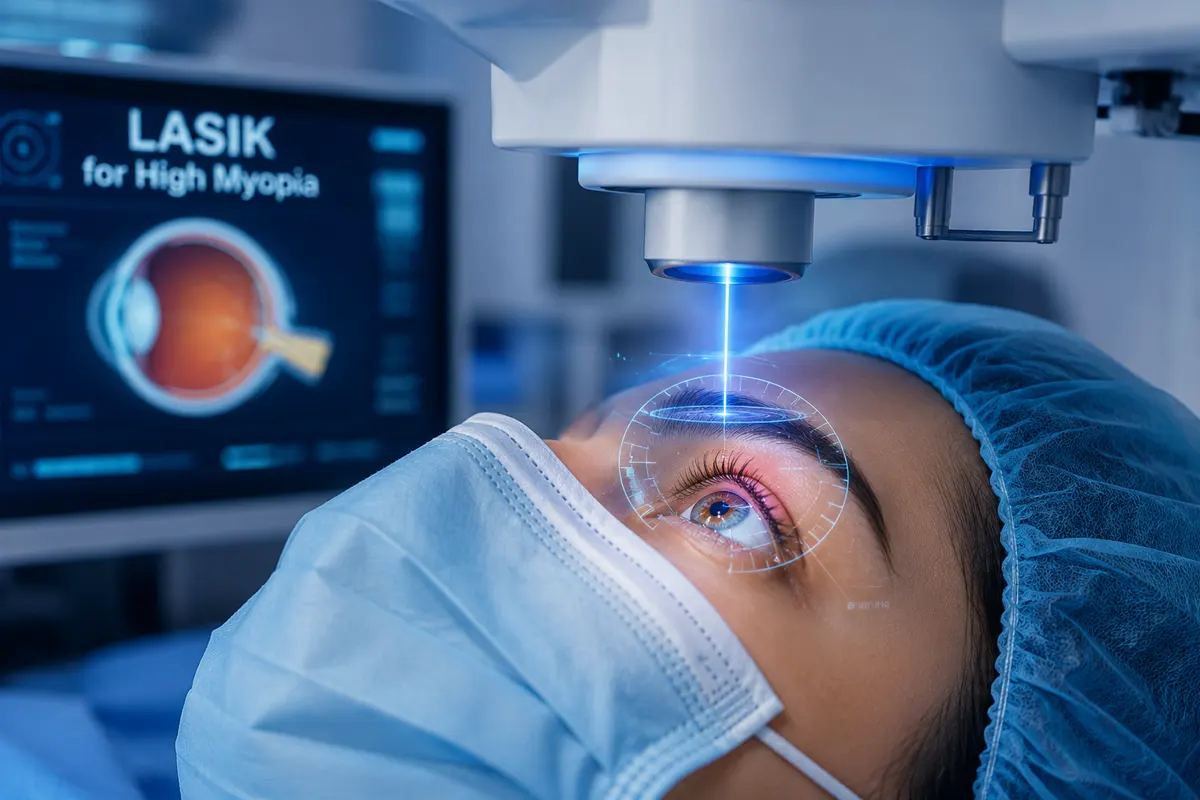
LASIK for High Myopia in Kuwait
Can LASIK Correct High Myopia?
High myopia, also known as severe short-sightedness, can make distant objects appear blurry and may lead to a strong dependence on glasses or contact lenses. For suitable patients, LASIK can reshape the cornea using advanced laser technology to correct refractive errors and improve distance vision.
However, not every person with high myopia is a suitable candidate for LASIK. A detailed eye examination is essential to determine whether LASIK is appropriate and whether another procedure, such as ICL or PRK/TransPRK, may be a better option.
What Is High Myopia?
High myopia occurs when the eye has a significant refractive error, causing light to focus in front of the retina instead of directly on it. Patients may experience blurred distance vision, difficulty seeing road signs, watching television, or recognizing objects from a distance.
A comprehensive assessment is important because high myopia can also be associated with other eye conditions that need to be evaluated before considering laser vision correction.
Is LASIK Suitable for High Myopia?
LASIK may be considered for selected patients with high myopia after a thorough examination. Your ophthalmologist may evaluate:
- Your exact glasses or contact lens prescription
- Corneal thickness
- Corneal shape and topography
- Tear film and dry-eye status
- Eye health and retinal condition
- Stability of your prescription
- Age and overall suitability for refractive surgery
The final treatment recommendation should always be based on an individual examination rather than prescription strength alone.
LASIK or ICL for High Myopia?
For some patients with very high myopia, thin corneas, or other factors that make corneal laser surgery less suitable, an implantable collamer lens (ICL) may be considered.
LASIK works by reshaping the cornea, while ICL involves placing a specially designed lens inside the eye without removing the natural lens.
Your ophthalmologist can compare the available options and recommend the procedure that best matches your eye measurements and visual needs.
What Happens During a LASIK Assessment?
Before treatment, the eyes undergo detailed testing to determine whether laser vision correction is appropriate. Depending on the examination, your ophthalmologist may assess corneal thickness and shape, refractive error, eye pressure, tear film, pupil characteristics and the overall health of the eyes.
These measurements help the surgeon develop an individualized treatment plan.
Benefits of LASIK for Suitable Patients
For appropriately selected patients, LASIK may:
- Improve distance vision
- Reduce dependence on glasses or contact lenses
- Provide rapid visual recovery compared with some other refractive procedures
- Improve convenience for work, travel and daily activities
Results vary from person to person, and glasses or contact lenses may still be required in some situations.
What If I Have Thin Corneas?
If your cornea is too thin or its shape makes LASIK unsuitable, your ophthalmologist may discuss alternative procedures. Depending on your individual eye condition, options may include PRK, TransPRK or ICL.
A detailed examination is the best way to determine which treatment is appropriate.
Book a LASIK Consultation in Kuwait
If you have high myopia and are considering laser vision correction, a comprehensive assessment with an experienced ophthalmologist can help determine whether LASIK or another vision-correction option is suitable for you.
YAS Eye Clinic provides ophthalmic evaluation and treatment options for patients seeking refractive vision correction in Kuwait.